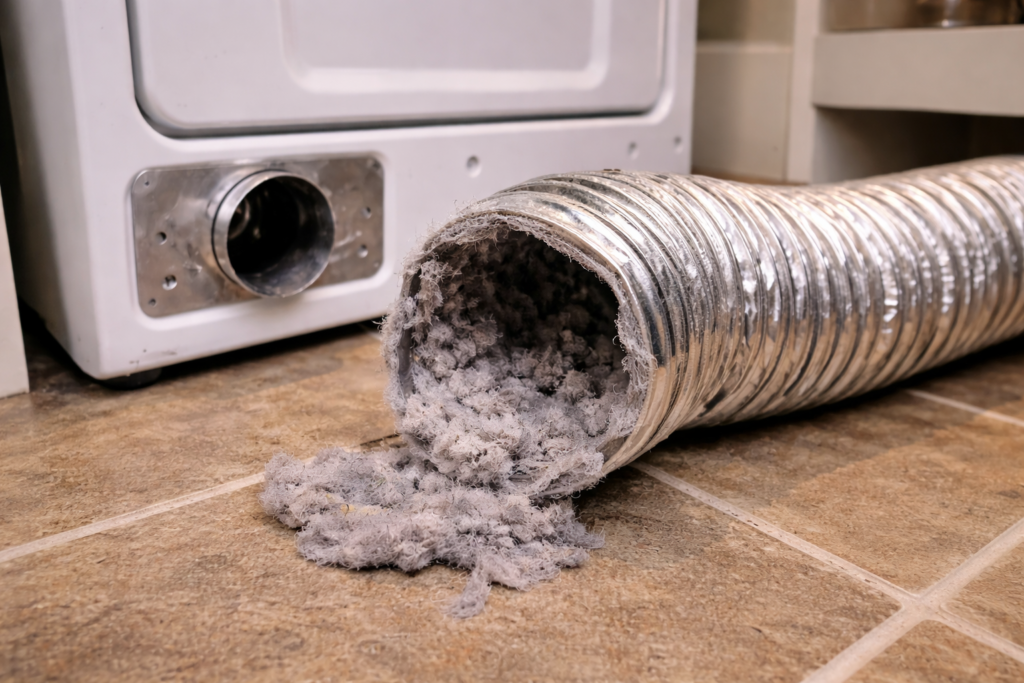
If a dryer thermal fuse blows more than once, there is almost always an underlying overheating problem.
Replacing the fuse without fixing the root cause will usually result in another failure.
For a full overview of symptoms, testing, and replacement, see Dryer Thermal Fuse: Complete Guide (Symptoms, Testing & Replacement).
The Most Common Cause: Restricted Airflow
Dryers rely on steady airflow to remove heat and moisture.
If airflow becomes restricted, internal temperatures rise quickly. When temperatures exceed the fuse’s rating, it blows.
Common airflow problems include:
-
Clogged lint filter
-
Lint buildup inside the vent hose
-
Crushed or kinked exhaust duct
-
Blocked exterior vent hood
-
Long or poorly routed vent runs
Even partial restrictions can cause overheating over time.
Lint Buildup Inside the Dryer
Lint does not only collect in the filter.
It can accumulate inside:
-
The blower housing
-
The exhaust duct
-
Around the heating element
Excess lint traps heat and increases internal temperatures.
Periodic internal cleaning may be required.
Faulty Cycling Thermostat
The cycling thermostat regulates normal drying temperature.
If it fails in the closed position, the heating element may stay on too long, causing excessive heat.
The thermal fuse then acts as a backup safety device and blows.
Blocked Blower Wheel
The blower wheel pushes hot air through the vent system.
If it becomes obstructed or damaged, airflow drops and heat builds up inside the dryer.
This condition can repeatedly trigger fuse failure.
Incorrect Replacement Fuse
Installing the wrong fuse can also cause problems.
If the replacement has a lower temperature rating than the original, it may blow prematurely.
Always match the correct part number or temperature specification.
How to Prevent It From Happening Again
Before replacing a blown fuse:
-
Clean the lint filter thoroughly.
-
Disconnect and inspect the vent hose.
-
Check for crushed ducting behind the dryer.
-
Inspect the exterior vent flap for obstructions.
-
Consider cleaning internal lint buildup if accessible.
Correcting airflow issues is the most important step.
When to Investigate Further
If airflow is clear and the fuse still blows, additional diagnosis may be required.
Possible issues include:
-
Failed cycling thermostat
-
Heating element grounding out
-
Electrical short
-
Control board malfunction
In these cases, professional inspection may be necessary.