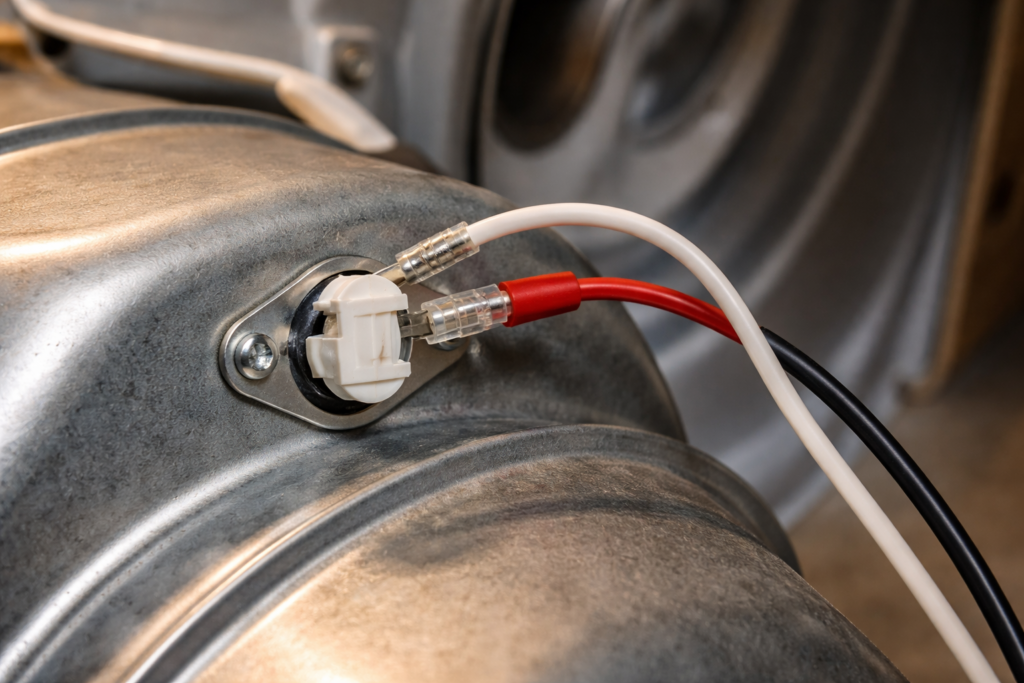
A dryer thermal fuse is a small safety device designed to prevent overheating. When it blows, the dryer usually stops running or stops heating.
This guide explains what a dryer thermal fuse does, how to identify failure symptoms, how to test it, and how to replace it safely.
Dryer thermal fuses are one of the most common failure points in modern dryers. When the fuse blows, the dryer may stop running completely or stop producing heat. Understanding how this small safety device works makes it much easier to diagnose common dryer problems.
What Is a Dryer Thermal Fuse?
A dryer thermal fuse is a heat-sensitive safety device installed inside most household dryers. Its purpose is to shut the dryer down if internal temperatures rise above a safe limit.
When excessive heat is detected, the fuse permanently opens the electrical circuit, stopping the dryer from running or preventing the heating element from operating. This helps protect the appliance from overheating and reduces the risk of fire.
Because a thermal fuse is a one-time safety component, it cannot be reset once it blows. The only solution is to replace it after correcting the underlying overheating problem.
What Does a Dryer Thermal Fuse Do?
A thermal fuse is a one-time safety switch.
If internal temperatures rise too high, the fuse blows and cuts power to either the motor or the heating element. This reduces fire risk and protects the dryer from serious damage.
Once it blows, it cannot be reset. It must be replaced.
For a detailed explanation, see What Does a Dryer Thermal Fuse Do?
Signs a Dryer Thermal Fuse Is Blown
Common symptoms include:
-
Dryer will not start
-
Dryer runs but does not heat
-
Dryer stops mid-cycle
-
Timer advances but drum does not turn
If your dryer will not start at all, read Will a Dryer Run If the Thermal Fuse Is Blown?
You can also review the full symptom list in Signs a Dryer Thermal Fuse Is Blown.
Will a Dryer Run If the Thermal Fuse Is Blown?
In most models, no.
Many dryers are designed so that if the thermal fuse fails, the motor circuit is interrupted and the dryer will not run at all. In some models, the drum may turn but there will be no heat.
Exact behavior depends on the manufacturer and wiring design.
For more detail, see Will a Dryer Run If the Thermal Fuse Is Blown?
How to Test a Dryer Thermal Fuse with a Multimeter
Testing a thermal fuse takes only a few minutes.
Steps:
-
Unplug the dryer.
-
Remove the rear or lower access panel.
-
Locate the thermal fuse on the blower housing or exhaust duct.
-
Disconnect the two wires.
-
Set a multimeter to continuity or the lowest ohms setting.
-
Touch one probe to each terminal.
Results:
-
No continuity (OL) means the fuse is blown.
-
Continuity (near 0 ohms) means the fuse is working.
See the full walkthrough in How to Test a Dryer Thermal Fuse with a Multimeter.
Where Is the Thermal Fuse Located on a Dryer?
The location depends on the model.
Most commonly, the fuse is mounted on:
-
The blower housing
-
The exhaust duct
-
Near the heating element housing
Front-access dryers may require removing the lower front panel.
For brand-specific instructions, see:
You can also review general positioning in Where Is the Thermal Fuse Located on a Dryer?
How to Replace a Dryer Thermal Fuse (Step-by-Step)
Replacing a dryer thermal fuse is straightforward.
Basic process:
-
Unplug the dryer.
-
Remove the access panel.
-
Disconnect the wires from the old fuse.
-
Remove the mounting screw.
-
Install the new fuse.
-
Reconnect the wires.
-
Reassemble the dryer.
Before installing a new fuse, check for airflow problems. A blocked vent is the most common reason a fuse blows.
For detailed instructions, see How to Replace a Dryer Thermal Fuse (Step-by-Step).
Why Does a Dryer Thermal Fuse Keep Blowing?
A blown fuse usually indicates another problem.
Common causes include:
-
Clogged lint screen
-
Blocked vent hose
-
Crushed exhaust duct
-
Faulty cycling thermostat
-
Obstructed blower wheel
Read the full explanation in Why Does a Dryer Thermal Fuse Keep Blowing?
How to Reset a Dryer Thermal Fuse (If Possible)
Most dryer thermal fuses cannot be reset.
They are designed as single-use safety devices. If the fuse has blown, replacement is required.
See How to Reset a Dryer Thermal Fuse (If Possible) for details.
Dryer Thermal Fuse vs Thermal Cutoff: What’s the Difference?
These are separate components.
-
A thermal fuse often protects the motor circuit.
-
A thermal cutoff typically protects the heating element.
They may look similar but are not interchangeable.
Learn more in Dryer Thermal Fuse vs Thermal Cutoff: What’s the Difference?
How Much Does a Dryer Thermal Fuse Cost?
Most thermal fuses cost between $8 and $25.
Universal replacement kits are widely available and often compatible with multiple brands.
See How Much Does a Dryer Thermal Fuse Cost? for a full breakdown.
Best Replacement Dryer Thermal Fuses (Universal Options)
When choosing a replacement:
-
Match the original part number if possible.
-
Confirm mounting hole alignment.
-
Verify temperature rating.
-
Never bypass the fuse permanently.
Recommended options are listed in Best Replacement Dryer Thermal Fuses (Universal Options).
Safety Reminder
Never operate a dryer with the thermal fuse bypassed.
It is a critical fire-prevention device. If a replacement fuse blows again, stop using the dryer and correct the underlying airflow or thermostat issue.