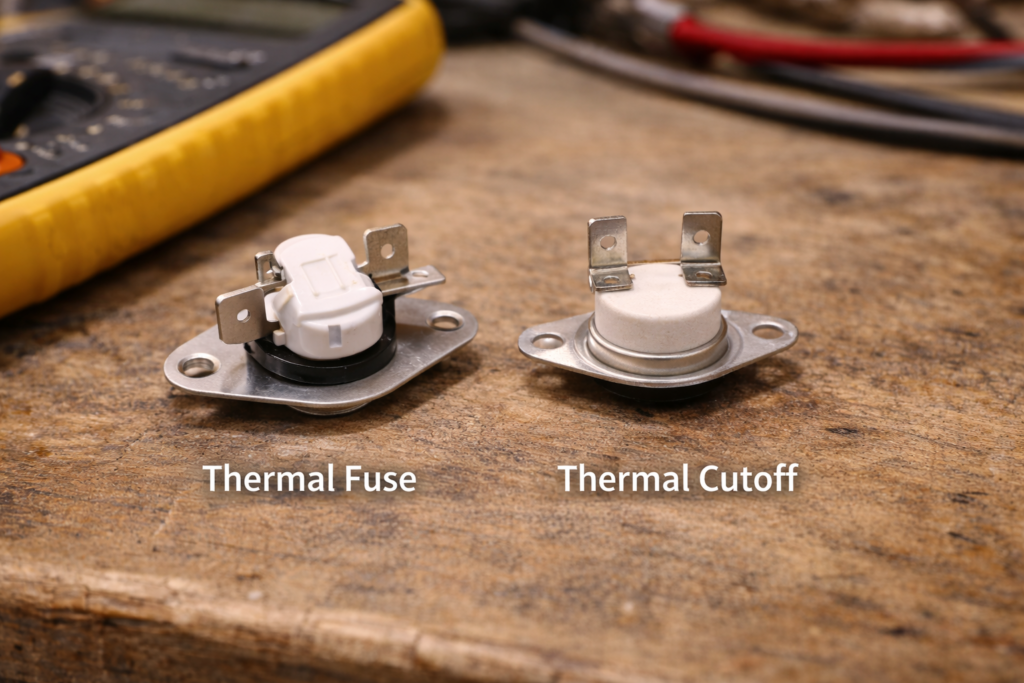
A dryer thermal fuse and a thermal cutoff are both safety devices, but they serve different purposes.
They may look similar and are sometimes located near each other, but they are not the same component.
For a full overview of testing and replacement, see Dryer Thermal Fuse: Complete Guide (Symptoms, Testing & Replacement).
What a Dryer Thermal Fuse Does
The thermal fuse is typically a one-time safety device.
When temperatures exceed its rated limit, it permanently opens the circuit. In many dryers, this cuts power to the motor or heating system.
If the fuse blows, the dryer may:
-
Not start at all
-
Run but not heat
-
Shut down mid-cycle
Once blown, it must be replaced.
What a Thermal Cutoff Does
A thermal cutoff is usually mounted on or near the heating element housing.
It protects the heating element specifically from extreme overheating.
If the thermal cutoff trips:
-
The dryer may still run
-
The drum may spin
-
There will be no heat
Like a thermal fuse, most thermal cutoffs are single-use and must be replaced if they fail.
Key Differences
Function:
-
Thermal fuse → Often protects the motor or overall power circuit
-
Thermal cutoff → Protects the heating element
Location:
-
Thermal fuse → Commonly mounted on blower housing or exhaust duct
-
Thermal cutoff → Mounted on heating element housing
Effect of Failure:
-
Blown thermal fuse → Dryer may not run at all
-
Failed thermal cutoff → Dryer runs but produces no heat
Why They Are Often Confused
Both parts:
-
Are small safety devices
-
Have two wire terminals
-
Are mounted with screws
-
Cannot usually be reset
Because they look similar, it is important to confirm the correct part before replacing it.
How to Identify the Correct Component
Check:
-
Your dryer model number
-
A parts diagram
-
The exact mounting location
Replacing the wrong component will not solve the problem.
If the dryer will not start, the thermal fuse is more likely the issue.
If the dryer runs but does not heat, the thermal cutoff or heating element may be involved.
Important Reminder
If either device fails, investigate airflow and overheating causes.
Common issues include:
-
Clogged vent hose
-
Lint buildup inside the dryer
-
Faulty thermostat
-
Restricted exterior vent
Correcting the root cause helps prevent repeat failures.
For a full overview of dryer thermal fuse problems, symptoms, testing, and replacement, see the Dryer Thermal Fuse Complete Guide.
## Related Dryer Thermal Fuse Guides
What Does a Dryer Thermal Fuse Do?